
B15 · Houseware & Kitchenware
Stainless Steel Sheet for Houseware & Kitchenware: 304/201 Selection and a 4-Part Checklist
For houseware and kitchenware, we have compiled 4 parts that use stainless steel: commonly 304 / 201 / 316, with thicknesses covering 0.3–5 mm.
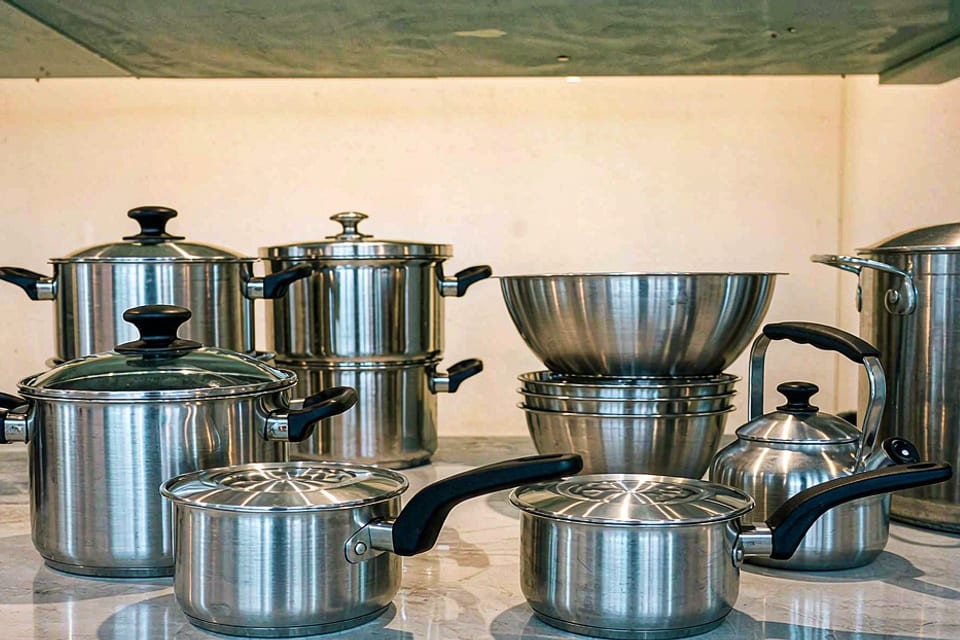
4 Parts and Material Selection Checklist
| Part / Component | Recommended Grade | Spec / Thickness | Surface | Main Failure Conditions | Reference Standard |
|---|---|---|---|---|---|
| Cookware / cups / vacuum flask liners | 304/316/201 | 0.3–1.2mm | 2B / electrolytic / polished | Food contact + salt/acid + cleaning + discoloration from dry burning | GB/T 3280; GB 4806.9 |
| Knives / blades | 420/440 | 1–5mm | Hardened + polished | Edge wear + chipping + acid corrosion from food | GB/T 1220; GB 4806.9 |
| Sinks / countertops / backsplashes | 304/201 | 0.8–3.0mm | 2B / brushed / embossed | Moisture + detergents + scratches + food contact | GB/T 3280; GB 4806.9 |
| Bathroom fittings / towel rails | 304/201 | 0.5–2.0mm | Mirror / brushed / plated | Moisture + soap + limescale + hand perspiration | GB/T 3280 |
The table showsstandard configurations. The same part may need to switch from 304 to 316L or 2205 under different media, temperatures and welding methods — describing the service conditions clearly is more efficient than specifying a grade directly.
Selection Highlights
- The most frequently specified grades in this industry are 304 (3), 201 (3) and 316 (1) — the numbers in brackets indicate how many parts involve each grade, serving as a starting point for quoting and material stocking.
- For acidic media, 316L is only a starting point; as concentration and temperature rise, consider 904L / duplex (2/4 items matched).
- Thickness spans 0.3–5 mm: thin sheets are mostly formed parts (accounting for bending springback and drawing cracks), while thick plates are mostly welded structural parts (accounting for heat input and sensitization).
FAQ
Which stainless steel is most used in houseware and kitchenware?
Based on the 4 parts in this catalog, the most common are 304 (3 items), 201 (3 items) and 316 (1 item). For any specific part, medium and temperature still matter — for example, a stainless steel worktop exposed to salt water should switch from 304 to 316L.
Which parts are most prone to problems?
Based on failure descriptions, the typical case is "Cookware / cups / vacuum flask liners": food contact + salt/acid + cleaning + discoloration from dry burning; recommended grades 304/316/201, spec 0.3–1.2mm. For such conditions, it is advisable to specify medium concentration, temperature and cleaning method at the drawing stage.
What thickness should generally be selected?
The thickness range in the checklist is 0.3–5 mm. Thin sheets are chosen for formability and surface, thick plates for weldability and structural strength; values also vary between equipment manufacturers for the same part, so verify against your drawings or service conditions.
Related Materials and Adjacent Industries
Delivery Cases for Similar Conditions
Cookware & Pot Making
Stainless Steel Circles · 0.4–3.0 mm
304 / 430 circles for cookware and pots: focused on deep drawing and surface treatment, shipped with EN 10204 3.1 material certificates, with optional batch Erichsen cupping tests and hardness sampling.
应用部位4 个
常用厚度0.3–5mm